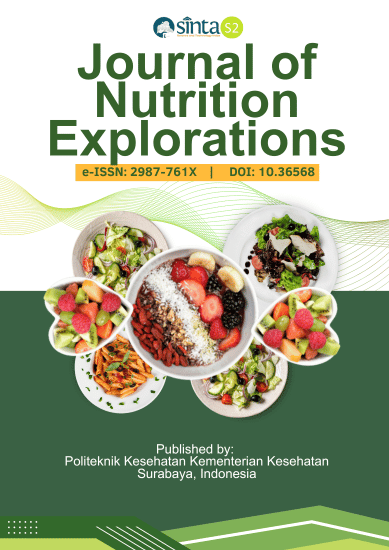
Development of Noodles with Pangasius Fish and Pumpkin Flour: Analysis of Iron and Protein Content
DOI:
https://doi.org/10.36568/jone.v4i4.791Keywords:
anemia, dry noodles, female adolescent, food product, pangasius fish, pumpkinAbstract
Iron and protein are essential nutrients for meeting dietary requirements. Local Indonesian foodstuffs rich in these nutrients include pangasius fish and pumpkin. This study aimed to formulate dried noodles using pangasius fish flour and pumpkin flour as substitutes and analyze their iron and protein content. This laboratory-based experimental study employed a completely randomized design with three dry noodle formulations containing different proportions of pangasius fish flour, pumpkin flour, and wheat flour: F1 (40%:50%:10%), F2 (40%:45%:15%), and F3 (40%:40%:20%). Each formulation was prepared in triplicate, and nutrient analyses were performed in duplicate. Protein content was determined using the Kjeldahl method, while iron content was analyzed using atomic absorption spectrophotometry. Results were expressed as mean ± standard deviation. Iron content ranged from 37.6145 ± 0.4305 to 46.505 ± 0.89 mg/kg, while protein content ranged from 19.03 ± 0.06% to 26.15 ± 0.06%. Formula F1 exhibited the highest iron content (46.505 ± 1.259 mg/kg) and protein content (26.15 ± 0.06%). Significant differences among formulations were observed for both iron content (p = 0.006) and protein content (p < 0.001). Formula F1 exhibited the highest iron and protein contents among the tested formulations. Pangasius fish flour was maintained at a constant proportion of 40% across all formulations, while the proportions of pumpkin flour and wheat flour were varied. Therefore, the differences in iron and protein contents among formulations were primarily associated with variations in the pumpkin flour-to-wheat flour ratio. Further studies should assess sensory acceptability, iron bioavailability, and nutritional efficacy.
References
Meilani N, Setiyawati N. Directly Observed Treatment for Iron Tablet Supplements Consumption Among Female Senior High School Students. Jurnal Kesehatan Masyarakat 2023;18(3):375–382; doi: 10.15294/kemas.v18i3.38594.
Wahyurin IS, Rahmah HA. Amount of Menstrual Blood and Nutrient Intake with Hemoglobin Level. Jurnal Kesehatan Masyarakat 2021;17(1):31–36; doi: 10.15294/kemas.v17i1.24540.
Kumari AS, Arumugam G, Babu S, et al. Pumpkin Seeds as a Natural Remedy for Anemia: Nutritional Insights and Therapeutic Potential. Current Therapeutic Research 2025;103:100797; doi: 10.1016/j.curtheres.2025.100797.
Khoirunnisa M, Devaera Y, Fahmida U, et al. Protein and iron intake adequacy among high school girls in Depok, Indonesia. World Nutrition Journal 2021;4(2):18–25; doi: 10.25220/WNJ.V04.i2.0004.
Indonesian Ministry of Health. Basic Health Research (RISKESDAS). Indonesian Ministry of Health: Jakarta, Indonesia; 2018.
Indonesian Ministry of Health. Indonesian Health Survey (SKI). Indonesian Ministry of Health: Jakarta, Indonesia; 2023.
Wu W, Yang Y, Sun N, et al. Food protein-derived iron-chelating peptides: The binding mode and promotive effects of iron bioavailability. Food Research International 2020;131:108976; doi: 10.1016/j.foodres.2020.108976.
de Escalada Pla MF, Flores SK, Genevois CE. Innovative strategies and nutritional perspectives for fortifying pumpkin tissue and other vegetable matrices with iron. Food Science and Human Wellness 2020;9(2):103–111; doi: 10.1016/j.fshw.2020.02.005.
Skolmowska D, Głąbska D. Analysis of Heme and Non-Heme Iron Intake and Iron Dietary Sources in Adolescent Menstruating Females in a National Polish Sample. Nutrients 2019;11(5):1049; doi: 10.3390/nu11051049.
Tiffany C. Timmer, Rosa de Groot, Judith J.M. Rijnhart, et al. Dietary intake of heme iron is associated with ferritin and hemoglobin levels in Dutch blood donors: results from Donor InSight. Haematologica 2019;105(10):2400–2406; doi: 10.3324/haematol.2019.229450.
Young I, Parker H, Rangan A, et al. Association between Haem and Non-Haem Iron Intake and Serum Ferritin in Healthy Young Women. Nutrients 2018;10(1):81; doi: 10.3390/nu10010081.
Pizarro F, Olivares M, Valenzuela C, et al. The effect of proteins from animal source foods on heme iron bioavailability in humans. Food Chem 2016;196:733–738; doi: 10.1016/j.foodchem.2015.10.012.
World Instant Noodles Association (WINA). Demand Rankings. Osaka, Japan; 2026.
Badan Pusat Statistik Kabupaten Bandung. Penduduk Indonesia Konsumsi Mie Instan 3 Bungkus per Bulan. Bandung, Indonesia ; 2025.
Ninčević Grassino A, Rimac Brnčić S, Badanjak Sabolović M, et al. Carotenoid Content and Profiles of Pumpkin Products and By-Products. Molecules 2023;28(2):858; doi: 10.3390/molecules28020858.
Mahalia LD, Mashar HM, Damiti SA. Analysis of protein, fat, and iron in catfish and green spinach biscuits. Jurnal Ilmiah Farmasi(Scientific Journal of Pharmacy) 2025;21(1):58–65.
Canti M, Siswanto M, Lestari D. Evaluasi Kualitas Mi Kering dengan Tepung Labu Kuning dan Tepung Ikan Cakalang (Katsuwonus pelamis) sebagai Substitusi Sebagian Tepung Terigu. agriTECH 2022;42(1):39; doi: 10.22146/agritech.53807.
Rustanti N, Murwani R, Anwar S. Combined Inorganic Iron (FeSO<SUB>4</SUB>) and Steamed Pumpkin (<I>Cucurbita moschata</I>) Fortification in Fresh Noodles Can Increase Hemoglobin Levels in Iron Deficient Mice. Pakistan Journal of Nutrition 2015;14(6):316–321; doi: 10.3923/pjn.2015.316.321.
Kaur S, Panghal A, Garg MK, et al. Functional and nutraceutical properties of pumpkin – a review. Nutr Food Sci 2019;50(2):384–401; doi: 10.1108/NFS-05-2019-0143.
PEREIRA AM, KRUMREICH FD, RAMOS AH, et al. Physicochemical characterization, carotenoid content and protein digestibility of pumpkin access flours for food application. Food Science and Technology 2020;40(suppl 2):691–698; doi: 10.1590/fst.38819.
Gavril (Rațu) RN, Stoica F, Lipșa FD, et al. Pumpkin and Pumpkin By-Products: A Comprehensive Overview of Phytochemicals, Extraction, Health Benefits, and Food Applications. Foods 2024;13(17):2694; doi: 10.3390/foods13172694.
Hatta H, Sandalayuk M. Pengaruh Penambahan Tepung Labu Kuning terhadap Kandungan Karbohidrat dan Protein Cookies. Gorontalo Journal of Public Health 2020;3(1):41; doi: 10.32662/gjph.v3i1.892.
Rathod NB, Pagarkar AU, Pujari KH, et al. Status of Valuable Components from Pangasius: A Review. Int J Curr Microbiol Appl Sci 2018;7(04):2106–2120; doi: 10.20546/ijcmas.2018.704.241.
Nurjanah FW, Hadisaputro S, Fatmasari D. Long Bean Leaf Extract for Improving Haematological Status of Female Adolescent with Anemia that Gets Fe Supplementation. Jurnal Kesehatan Masyarakat 2020;16(1):81–87; doi: 10.15294/kemas.v16i1.23203.
Sulistyaningrum H, Swastawati F, Mexitalia M, et al. Catfish Oil (Pangasius hypophthalmus) effect to ferritin and sTfR in iron deficiency anemia. Jurnal Gizi Indonesia (The Indonesian Journal of Nutrition) 2021;10(1):28–35; doi: 10.14710/jgi.10.1.28-35.
Handayani OWK, Hasbullah M, Mardiana M, et al. Wisdom of Local Food Ingredients as an Enhancer to Food Supply for Diabetes Mellitus Prevention. Jurnal Kesehatan Masyarakat Kemas 2024;20(2):346–353.
Faradila MD, Adyas A, Karyus A, et al. Analysis of Blood Supply Tablet Program Management in an Effort to Reduce the Prevalence of Anemia Among Female Students in Pesawaran District, Indonesia in 2025. Health Dynamics 2025;2(6):262–266; doi: 10.33846/hd20607.
Mamun A Al, Mahmudiono T, Yudhastuti R, et al. Effectiveness of Food-Based Intervention to Improve the Linear Growth of Children under Five: A Systematic Review and Meta-Analysis. Nutrients 2023;15(11):2430; doi: 10.3390/nu15112430.
Downloads
Published
How to Cite
Issue
Section
License
Copyright (c) 2026 Mars Khendra, Lamia Diang Mahalia, Legawati Legawati, Abdullah Al Mamun

This work is licensed under a Creative Commons Attribution-ShareAlike 4.0 International License.
All articles published in the Journal of Nutrition Explorations are licensed under the Creative Commons Attribution–ShareAlike License (CC BY-SA 4.0).
Under this license, users are permitted to read, download, copy, distribute, print, search, and link to the full texts of the articles, as well as adapt and build upon the material for any purpose, including commercial use, provided that appropriate credit is given to the original author(s) and the source.
Any derivative works based on the published articles must be distributed under the same Creative Commons Attribution–ShareAlike (CC BY-SA 4.0) license.
Authors who publish with the Journal of Nutrition Explorations retain the copyright of their work. By submitting and publishing their manuscripts in this journal, authors grant the journal the right of first publication.
The Journal of Nutrition Explorations supports the principles of open access, ensuring that all published articles are freely available online without subscription or access fees.
Author Rights
Authors retain the following rights:
-
The right to share and distribute their published article.
-
The right to use the article for academic and educational purposes.
-
The right to deposit the article in institutional or subject repositories.
-
The right to include the article in future books, theses, or other scholarly works.
Licensing Information
All articles are published under the Creative Commons Attribution–ShareAlike 4.0 International License (CC BY-SA 4.0).
More information about this license can be found at:
https://creativecommons.org/licenses/by-sa/4.0/